Cart-Type vs. Top-Mounted Dental Units
“Cart-type” means it stands on a wheeled base. A cart-type dental unit supports the dentist’s instrument delivery console on a separate mobile cart. “Top-mounted” refers to the instrument delivery arrangement, in which instrument hoses are supported from above the delivery console by raised instrument arms. This arrangement is commonly described as an over-the-top delivery system.
How Is a Cart-Type Dental Unit Designed?
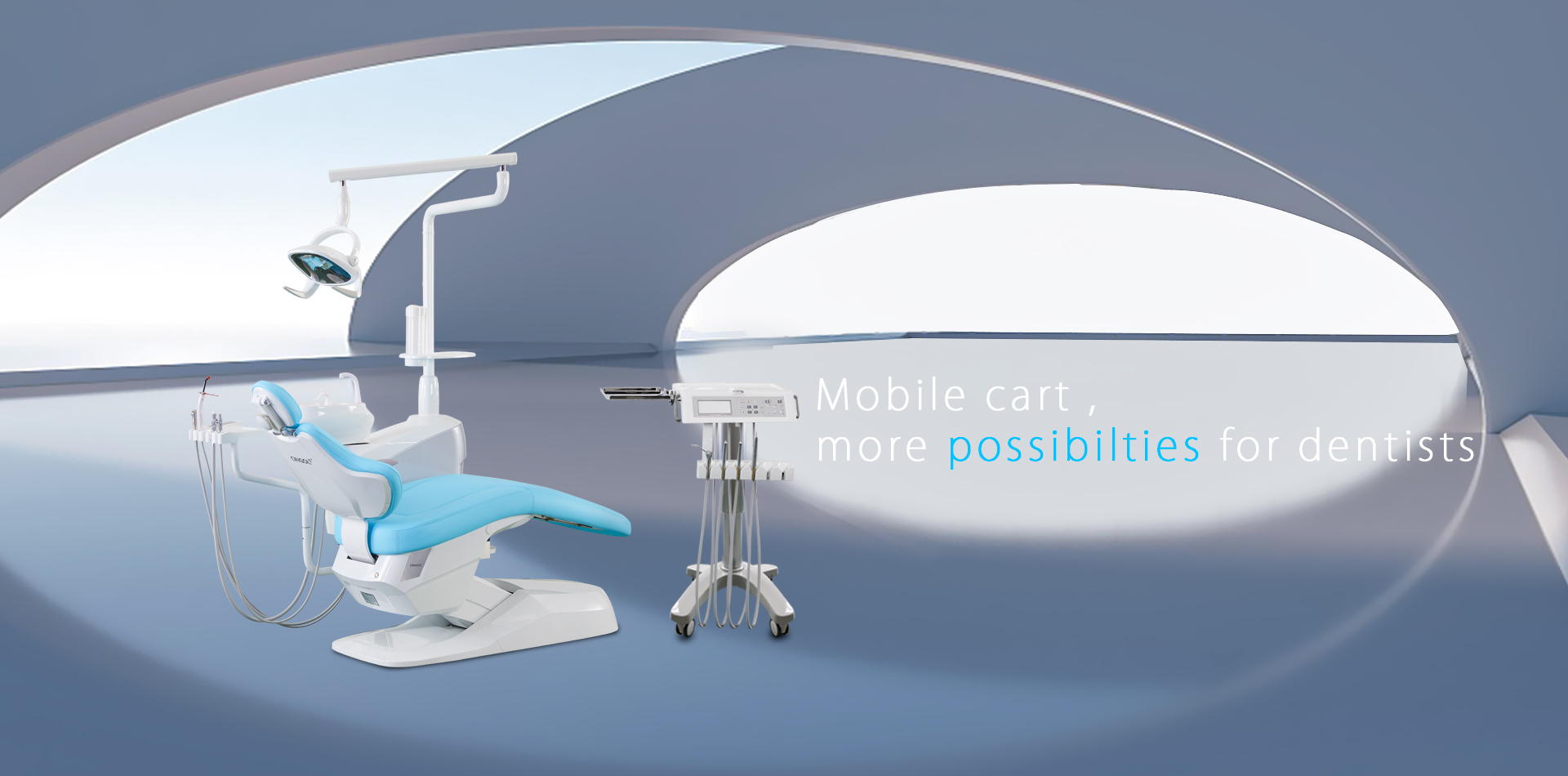
A cart-type dental unit places the dentist’s delivery console on a wheeled base, usually supported by a central column. The console carries the instruments and operating controls, while the base supports the assembly independently of the patient chair.
The cart’s structure lets you reposition the delivery console by moving the base. Depending on the design, the console may also be height-adjustable. These are separate movements: moving the cart changes its location, while adjusting the column changes the working height of the instrument console. For example, CINGOL’s X3 standard cart model is described with an electric lifting system for its main instrument tray, illustrating one way to provide this adjustment.
Instrument Holders, Tubing and Controls
The delivery console combines instrument holders, hose connections, and a control interface. The holders keep instruments in their resting positions, while the tubing carries the supplies required by the connected equipment. A tray surface may be incorporated into the console or provided as a separate attachment.
Hose management is another design consideration. The position of the holders and the routing of the tubing determine how the hoses extend from the console when instruments are lifted. Although hanging hoses are common on cart systems, the wheeled support—not a particular hose arrangement—is what defines the cart-type format.
Controls may be located on the console, with a foot control operating supported instrument or unit functions. The cart also requires the connections specified for its equipment, so those connections still govern its movement. A movable instrument console does not necessarily operate independently of the rest of the dental unit.
How Is a Top-Mounted Dental Unit Designed?
Instrument Delivery Assembly
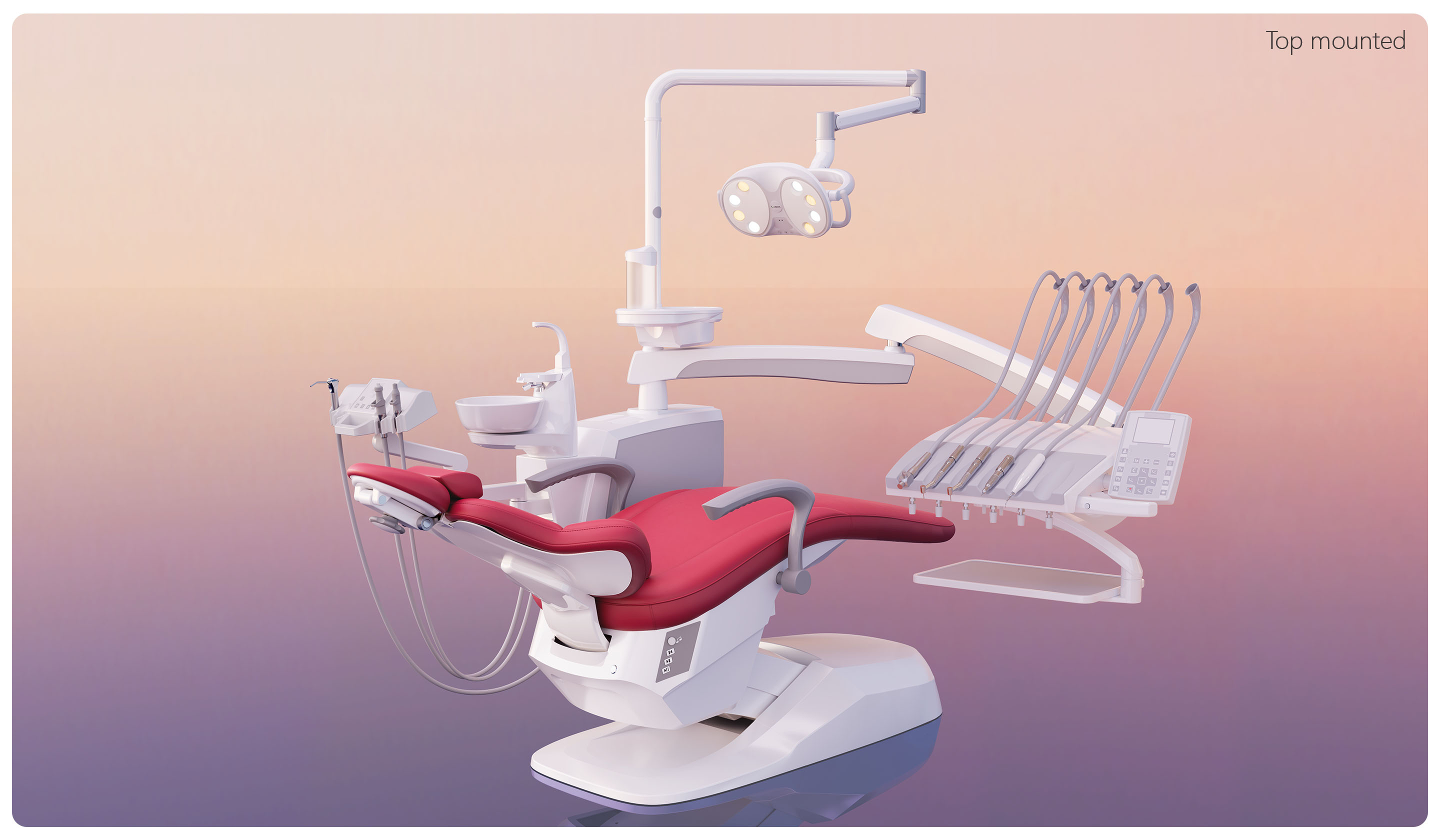
In a top-mounted configuration, the delivery console carries a row of raised instrument arms above its upper surface. Instrument hoses pass over these arms before reaching the handpieces in their resting positions. This gives the assembly its characteristic over-the-top hose arrangement.
The instrument arms and the console’s supporting arm perform different jobs. The smaller arms support individual hoses, while the larger supporting arm carries the console. On an arm-supported unit, the console can be repositioned through the movement allowed by that support assembly.
Instrument Support and Control Features
When you lift an instrument, its hose extends from the support above the console. The support mechanism manages the hose as the instrument moves away from its resting position. Available reach and movement depend on the arm and hose design.
The console also houses the controls provided for the unit and its connected instruments. The console may incorporate buttons or a display, or position them alongside it, while a foot control operates the assigned functions. The over-the-top hose arrangement does not, by itself, determine which controls or digital functions are included.
For example, CINGOL’s X3 NEW Top-Mounted Disinfection Dental Chair/Dental Unit incorporates the newly developed CINGOL Ark System, enabling visual touchscreen control of dental chairs and instruments, integrated multi-modal imaging (CBCT/intraoral scans), multi-terminal coordination, and voice interaction - creating a fully integrated smart-digital dental treatment environment.. These illustrate model-specific adjustments within a top-mounted design.
Cart-Type vs. Top-Mounted: Key Product Differences
The clearest distinction is the combination of console support and hose routing. A wheeled base describes how the console is carried; an over-the-top arrangement describes how the instrument hoses are supported.
|
Design element |
Cart-type configuration |
Top-mounted configuration |
|
Console support |
A column and wheeled base carry the instrument console separately from the patient chair. |
A support arm carries the instrument console as part of the dental unit assembly. |
|
Console movement |
The console moves with the cart. Height adjustment may be available, depending on the model. |
The console moves within the range of its supporting arm. Rotation or height adjustment depends on the model. |
|
Instrument resting position |
Instruments sit in holders on the console, with hoses hanging below in the configuration compared here. |
Instruments rest at the console, with their hoses routed over raised instrument arms. |
|
Hose support |
The hanging hoses extend from their connections as instruments are lifted. |
Raised arms support the hoses above the console as instruments are lifted. |
|
Controls and equipment |
The control interface and fitted instruments depend on the selected configuration. |
The control interface and fitted instruments depend on the selected configuration. |
Cart-Type and Top-Mounted Models in the CINGOL X3 and X5 Series
CINGOL offers cart-type and top-mounted models within both the X3 and X5 series. The series name identifies the product family, while the delivery-format name helps distinguish the instrument console arrangement.
X3 Cart-Type and Top-Mounted Models
The X3 standard cart model carries the console on a separate mobile base, while the top-mounted version shown by CINGOL uses raised hose-support arms on an arm-supported console.
X5 Cart-Type and Top-Mounted Models
X5 catalog also lists cart-type and top-mounted versions, including NEW-labelled models. When reviewing them, use the complete product name and the corresponding specification to distinguish the delivery assembly from other features. A cart or top-mounted designation alone does not establish the included instruments or control functions.
To explore either format, request the current product images and configuration sheet for the specific X3 or X5 model.